Industrial Crane Manufacturer: 12 Questions That Separate Real Factories from Middlemen
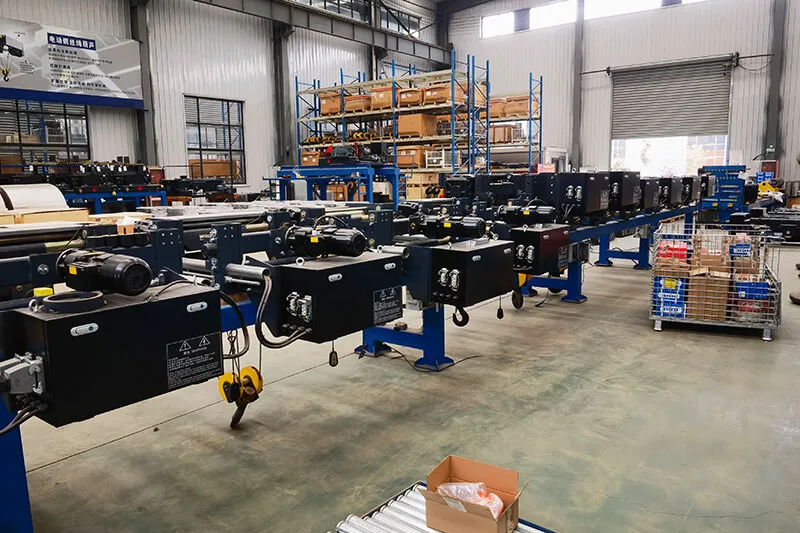
How to vet an industrial crane manufacturer — factory vs trader, certificates, load testing, spare parts and the questions that reveal the difference.
Why This Matters for Your Project
The market is full of companies that will happily sell you an industrial crane. A smaller number actually manufacture them. The difference matters because a crane is a 10–20 year asset that gets load-tested, inspected and — when something goes wrong — needs a factory that still exists and still stocks the parts.
These are the twelve questions we tell buyers to ask any industrial crane manufacturer, whether they end up talking to us or not. They are designed to be asked in one phone call, and the answers separate a factory from a trading desk surprisingly fast.
1. Are You the Manufacturer, or the Agent?
The first question is the most direct. A factory will describe its own plant, welding lines, machining and testing equipment, and will usually offer a plant visit or video tour. A trader will talk about "our partners" and "our factories" in the plural. Neither is inherently bad — some traders provide great service — but the contract, warranty and spare parts all behave differently when the manufacturer is a third party.
2. Where Is the Factory, and Can I See It?
Ask for the factory address and verify it. Most real Chinese crane factories are concentrated in a few industrial clusters — Changyuan in Henan is one of the largest crane manufacturing bases in the country. Video tours and third-party audits are standard practice for serious manufacturers. A vague answer, or an address that turns out to be an office block, is a red flag.
3. Which Certificates Apply to My Market, Specifically?
The blanket answer "we have all the certificates" is a non-answer. ISO 9001 is the baseline management-system certificate and nearly every factory has it. What matters for your project is the certificate that works in your country: CE for the EU, SABER for Saudi Arabia, and third-party inspection (SGS, BV, TÜV) for many other markets.
Ask the manufacturer to name the exact certificate for your destination and to send the document. If they hesitate, they have probably not shipped to your region before — which is not disqualifying, but it changes how you should structure the contract and inspection.
4. What Was the Last Country You Shipped To?
Export history is a practical proxy for documentation competence. A manufacturer that has shipped to your region knows the local inspection requirements, the certificate formats and the common customs pitfalls. Ask for the export list or a couple of reference projects in your area. Our own export record covers 50+ countries, and we can usually point to a similar project in the buyer's region.
5. What Is the Load Test Procedure?
Every crane should be load-tested before shipment. Confirm the procedure: static test at 100% of rated capacity, proof test at 125%, who witnesses it, and whether the test report ships with the crane. Third-party inspection on request is a mark of a factory that is confident in its work.
6. Can I See the Drawing Package Before Ordering?
A real manufacturer designs the crane around your building — capacity, span, lifting height, duty class, controls — and will share general arrangement drawings and key calculations before you sign. A trader sends you a brochure. The difference is visible immediately: real drawings carry dimensions, rail loads, wheel loads and motor data; brochures carry pictures.
7. What Duty Classes Do You Build To?
Ask about working class (A3–A8, FEM, ISO) and how the manufacturer determines it for your application. If the answer is "we build everything," probe deeper. Duty class drives the structural and mechanical design, and it is where cheaper quotes quietly hide — a crane quoted for A3 duty that will actually run A6 will fail years early.
8. What Is the Lead Time, and What Can Delay It?
Typical production for an overhead crane is 4–8 weeks depending on configuration, plus packing and shipping. Ask what the milestone schedule looks like: design approval, steel fabrication, load test, dispatch. A manufacturer that cannot name its milestones cannot manage its schedule.
9. What Happens After Delivery? Installation, Commissioning, Training
Cranes are installed by erectors and commissioned by technicians. Confirm whether installation supervision is included, whether commissioning support is remote or on-site, and whether operator training is available. For a first-time buyer in a new region, this support is often the difference between a two-week startup and a two-month one.
10. Where Do Spare Parts Come From, and How Fast?
Ask which parts are stocked, where the stock is held, and the delivery time for a replacement motor, brake or control board. A factory with its own hoist and electric production can supply parts for decades; a trader depends on whoever manufactured the components, and that channel can close without notice.
11. What Do the Payment Milestones Look Like?
Industry-standard terms are a deposit at contract signing, a milestone payment against the load test, and the balance against shipping documents. Any request for full prepayment, or for the balance before inspection, should be treated with caution. Payment milestones that track real deliverables protect both sides.
12. What Happens If Something Fails in Year Three?
The most important question is also the one nobody asks. Ask how the manufacturer handles warranty claims after commissioning, who pays for freight on a defective part, and what the design life of the crane is under your duty cycle. The answer tells you more about the company than all the brochures combined.
How to Use These Questions in a Real Procurement
You do not need to fire all twelve questions like an interrogation. The most effective way is to send them as a short list with your inquiry, and let the supplier answer in writing. Written answers are better than phone answers for a simple reason: they are evidence. When a supplier has put a commitment in writing about certificates, load test procedure or spare parts lead time, they will honour it differently than a verbal "sure, no problem."
A practical sequence: start with question one and two in your first email, because they are the fastest filter. If the company is an agent, the conversation is not over — you just need to know it, because the warranty and spare parts will flow through them. Then move to questions three, four and five for any shortlisted supplier. The remaining seven questions are for the finalists, ideally on a call or during a video tour.
One more tip: keep the answers in one place. A simple table with the twelve questions as rows and one column per supplier makes the comparison visible in five minutes. Buyers who skip this step often realize too late that they compared prices but never compared certificates, load testing and spare parts.
Red Flags That Do Not Need a Question
Some signals do not need a question at all. A supplier who cannot give a factory address quickly, who sends stock photos instead of drawings, who quotes a price that is 40% below the market without explanation, or who is reluctant to put anything in writing — each of these is a reason to slow down, whatever the answers to the twelve questions sound like.
The cheapest quote is only cheap if the crane arrives, installs and runs for its design life. In our experience, the projects that fail are rarely the ones with the highest prices; they are the ones where nobody checked the factory behind the quotation.
The Checklist in Action
Run through the twelve questions in a single call. A genuine industrial crane manufacturer answers all of them with specifics; a middleman answers most of them with generalities. You do not need perfect answers to every question — you need to see which company stops being vague when pushed.
We put FLAGCRANE through this same test on every project: factory tours on request, export records across 50+ countries, CE and SABER documentation for the markets that need it, load testing before dispatch with third-party inspection available, and a delivery process that covers specification review, design, manufacturing, load testing, packing and international shipping. Ask us any of the twelve questions at [email protected] or WhatsApp +86 13156233808 — we will answer in writing.
Related reading: the five things to confirm before buying a crane from China, our factory profile, and the full crane product range.